
By research volunteer Paul J Treacy
---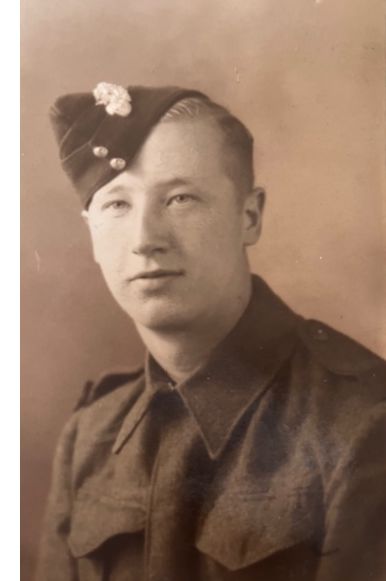 Although we get dozens of enquiries requesting our help in researching
previous members of the Royal Fusiliers (City of London) Regiment there are not
many who want to go to the site of a relative killed in North Africa. Lee
Bovington is one of the few.
Although we get dozens of enquiries requesting our help in researching
previous members of the Royal Fusiliers (City of London) Regiment there are not
many who want to go to the site of a relative killed in North Africa. Lee
Bovington is one of the few.
George was born on the 4th July 1922 to Percy Edward and Ada
Mary Pearce of 157 Guinness Buildings, Islington, London and was baptised three
weeks later at St. Clements Church, City Road.
Lee is related to George as a Great Nephew but knew little
of his short life with the 2nd Battalion Royal Fusiliers and wanted to find out
more. This he decided would include a visit to the area in which George fought
and a visit to the Commonwealth War Graves site where he is commemorated.
Currently we have no service records for George. Until they
are released to Lee we have to rely on the 2nd Battalion’s histories, War Diary
and maps to triangulate what the individuals service history might have looked
like. We are unsure when George joined the Regiment but believe it to be early
1940 and it is unlikely that he served in France prior to the Dunkirk
evacuation. His service number was 6481513.
The Battalion took on replacements when it returned from
France and was stationed in various parts of the UK until their last posting to
Hawick where they remained until November 1942 when the Battalion made ready to
transfer to North Africa. George was to serve in ‘X’ Company.
Before leaving George married Elizabeth Wheeler in Islington
during January 1943.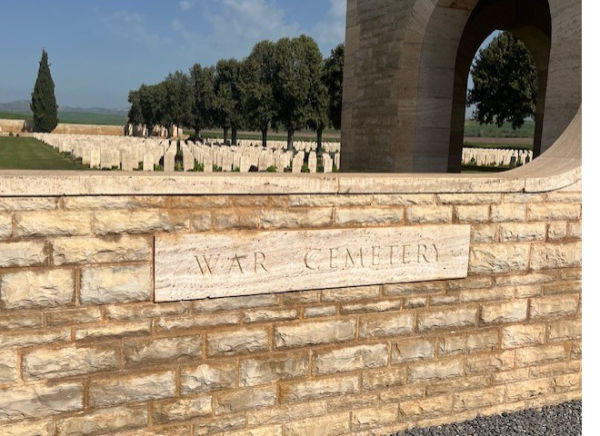 The Battalion left the Liverpool on the SS Cuba in early March
1943 and arrived in Algiers on the 26th March and moved into Tunisia taking frontline
positions at Frenchman’s Hill near to Djebel Munchar on the 7/8th April. The
Battalion slowly moved forward arriving at south of Medjez el Bab on the 21st
April. On the night of the 23/24th April the Battalion were to take part in an
action known as The Battle of Peter’s Corner. Within the next twenty-four hours
George was killed in action. Lee believes that fellow Fusilier Wynn and L/Cpl
Merry were also killed nearby. At about the same time the Battalion Commanding
Officer Lt. Col. Brandon, was also killed, having been with the Royal Fusiliers for some time as the RSM for 1st Battalion in May 1939 before rapid promotion.
The Battalion left the Liverpool on the SS Cuba in early March
1943 and arrived in Algiers on the 26th March and moved into Tunisia taking frontline
positions at Frenchman’s Hill near to Djebel Munchar on the 7/8th April. The
Battalion slowly moved forward arriving at south of Medjez el Bab on the 21st
April. On the night of the 23/24th April the Battalion were to take part in an
action known as The Battle of Peter’s Corner. Within the next twenty-four hours
George was killed in action. Lee believes that fellow Fusilier Wynn and L/Cpl
Merry were also killed nearby. At about the same time the Battalion Commanding
Officer Lt. Col. Brandon, was also killed, having been with the Royal Fusiliers for some time as the RSM for 1st Battalion in May 1939 before rapid promotion.
The Fusilier Museum was able to help in locating the Peter’s
Corner, battle area from the war time map which shows similar road networks to
the that of the present day. Sadly, George’s body was never recovered, and his death is
acknowledged on column Face 15 at the Medjez al Bab Commonwealth War Graves Cemetery.
Following his death, the family received a letter from his Company Commander Captain Jarrad who also sustained minor
wounds during the same engagement.
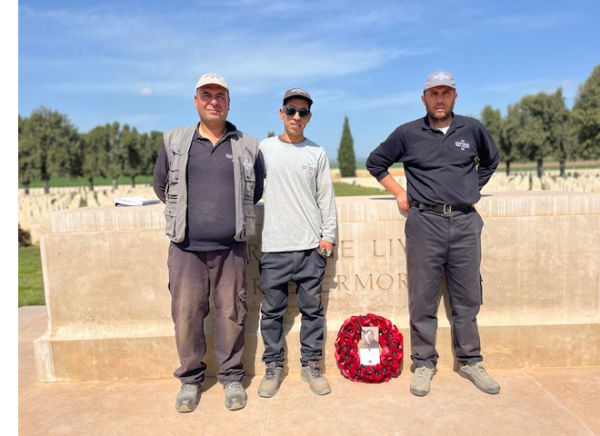 LEE’s PILGRIMAGE
Lee was unaware of George or that he been killed during the
war, but when he found out promised his Grandmother that he would visit the
area and pay his respects. This he did during March 2025. As well as visiting
CWGC Medjez al Bab he also visited the CWGC site at Massicault. In the former he deposited earth taken from
the Tower of London, the Royal Fusiliers Regiments home.
Lee was assisted in his visit by two members of the Tui
team, Hamadi Zarrouk, his guide, and Ali, his driver; both were exceptional in
their knowledge and planning of the visit, especially as it was during Ramadan.
He also wishes to mention the three CWGC gardeners, whom he found humble and
respectful.
The gardeners told Lee that Mohammed Akdar Ben Atiia, a local landowner, had given the land (formerly used as a field hospital) to build the Medjez el Bab cemetery in the area.
ONE OF MANY
Unfortunately, George Pearce was one of one hundred and six
who were to be killed in North Africa whilst serving with the Second Battalion.
In total three hundred and sixteen Officers and men died in
this Battalion during the war with a further seven hundred and eighty-seven
being wounded, missing or PoW’s.
Archived posts
Browse our old blog posts